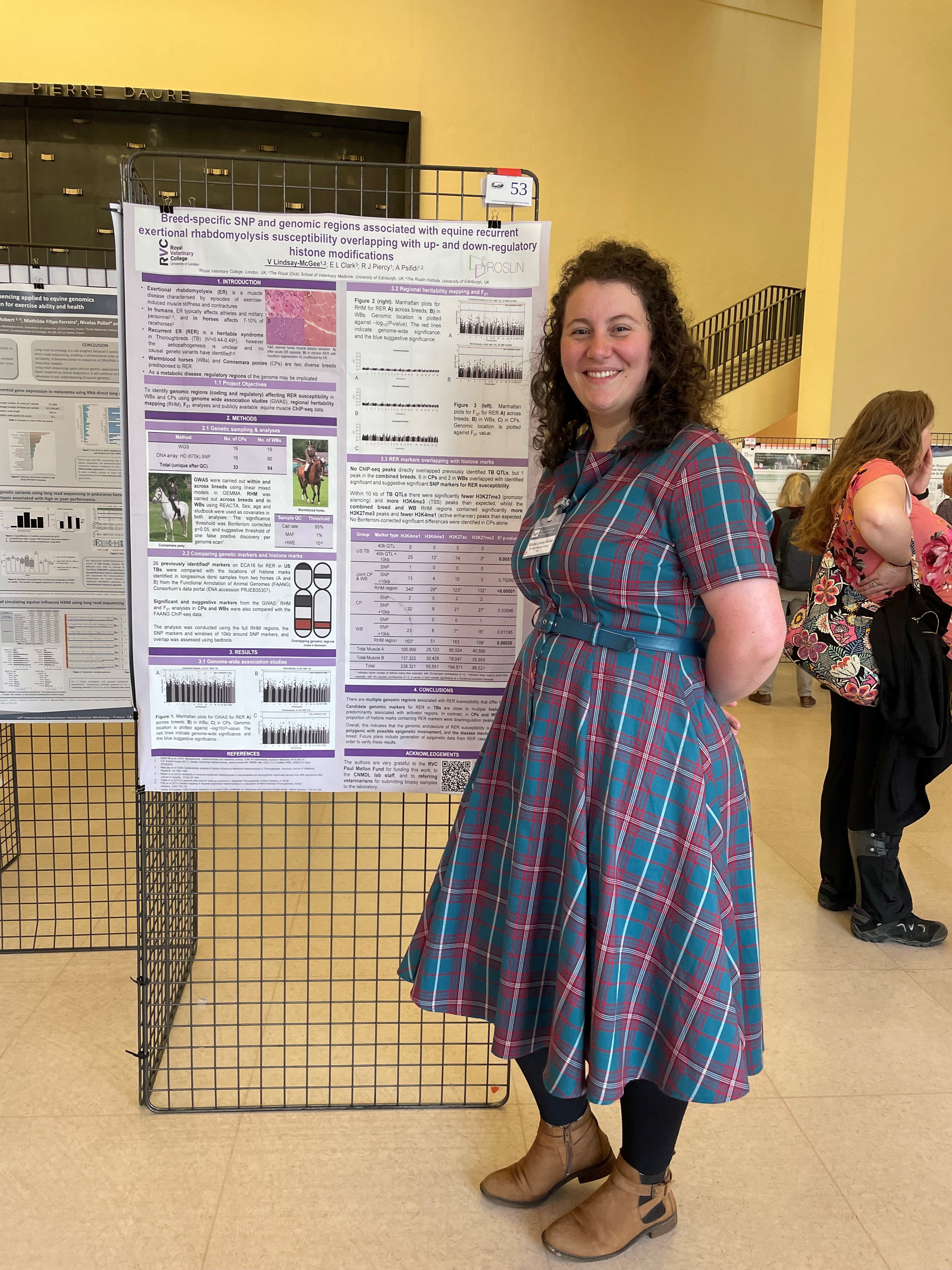
Dr Victoria Lindsay-McGee

About me

I am an equine geneticist and veterinary data analyst, and Programme Coordinator for the postgraduate Equine Science MSc programme at the University of Edinburgh’s Royal (Dick) School of Veterinary Studies. My research sits at the intersection of equine genetics and genomics, veterinary clinical data, exercise physiology, performance and welfare. I am particularly interested in complex traits where genetics, environment and human management interact, and in developing better ways to use clinical and population data to understand these traits.

My research has its roots in equine clinical practice. I began my career working with the Scottish SPCA and subsequently established a business in equine thermography, alongside completing an MSc in Equine Science at Edinburgh. My MSc research investigated infrared thermography as a potential diagnostic tool for equine myopathies, which led to a continuing interest in equine muscle disease and exercise physiology.

I subsequently completed an MSc in Instrumental Analytical Science at Robert Gordon University, specialising in DNA analysis, proteomics and metabolomics. As part of an Erasmus traineeship at the Universidade do Minho in Portugal, I investigated the role of antioxidant genes in a treatment for neurodegenerative disease using C. elegans models. This provided a foundation in molecular genetics and experimental approaches that I later applied to equine disease.

I completed my PhD at the Royal Veterinary College, investigating the genetic architecture of equine exertional rhabdomyolysis (tying-up), supervised by Dr Androniki Psifidi, Professor Richard Piercy and Dr Emily Clark. My doctoral research combined clinical phenotyping, statistical analysis and genomic approaches to investigate the biological and genetic heterogeneity underlying this complex group of muscle disorders. I was awarded the RVC McKeever Prize for the best original research paper by a graduating PhD student in 2023.

Since then, my research has broadened from individual diseases to wider questions about equine health, performance and welfare. I am interested in how selective breeding and population history influence disease susceptibility, how clinical records can be used to identify meaningful disease subtypes and predict outcomes, and how genetic and phenotypic information can be translated into useful knowledge for horse owners, breeders and veterinary professionals. Current work includes systematic analysis of equine GWAS data, equine genetics stakeholder research, inbreeding and performance, and collaboration between equine veterinarians and farriers to improve equine wellbeing.

Alongside my research, I am a teaching-focused academic. I teach equine exercise physiology, genetics, research methods and data analysis, and contribute to veterinary medicine and postgraduate education incluidng the Equine Science MSc and Data-Driven Breeding and Genetics MSc. I am particularly interested in how we teach students to critically evaluate evidence, use data appropriately and work with emerging technologies such as generative AI. I also have a broader interest in veterinary humanities and in the relationships between scientific knowledge, professional practice and human decision-making around animals.

I am a representative of the British and Irish Society of Animal Science on the [i]animal[/i] journal family management board, and I am part of the BISAS Undergraduate Thesis of the Year Award judging committee. I was on the Organising Committee for the 2025 BISAS Equine Conference. I am also a Royal Statistical Society accredited Data Analyst.

Outside academia, I am a lifelong horse rider with interests in dressage and eventing, and have experience producing young horses and coaching young riders. I am also an active rugby union referee (and winner of the Scottish Rugby National Community Referee of the Season 2024/25).

Research Interests

My research focuses on using genetics, genomics and data science to understand complex problems in equine health, performance and welfare.

  • Equine genetics and genomics
    • Genetic and genomic architecture of complex equine traits
    • Genetic susceptibility to disease
    • Equine exertional rhabdomyolysis and other neuromuscular disorders
    • Population genetics, inbreeding and the consequences of artificial selection
    • Genetic influences on performance and exercise-related traits
    • Genetic susceptibility to infectious disease
    • Cross-phenotype and genome-wide association approaches
  • Veterinary and equine health data
    • Statistical modelling of equine health and performance data
    • Disease subtyping using clinical records
    • Retrospective analysis of veterinary clinical data
    • Phenotyping complex and heterogeneous diseases
    • Predictive modelling and risk-factor analysis
    • Integrating clinical, phenotypic and genomic data
  • Equine exercise, performance and welfare
    • Equine muscle physiology and exercise-associated disease
    • The interaction between genetics, environment and management
    • Evidence-based approaches to equine performance and welfare
    • Human behaviour and decision-making in equestrian practice
    • Communication and collaboration between equine professionals
  • Veterinary education and humanities
    • Data literacy and research methods in veterinary education
    • Use of generative AI in postgraduate veterinary education
    • Evidence-informed teaching and assessment
    • Veterinary humanities and the relationship between scientific knowledge, professional practice and animal welfare